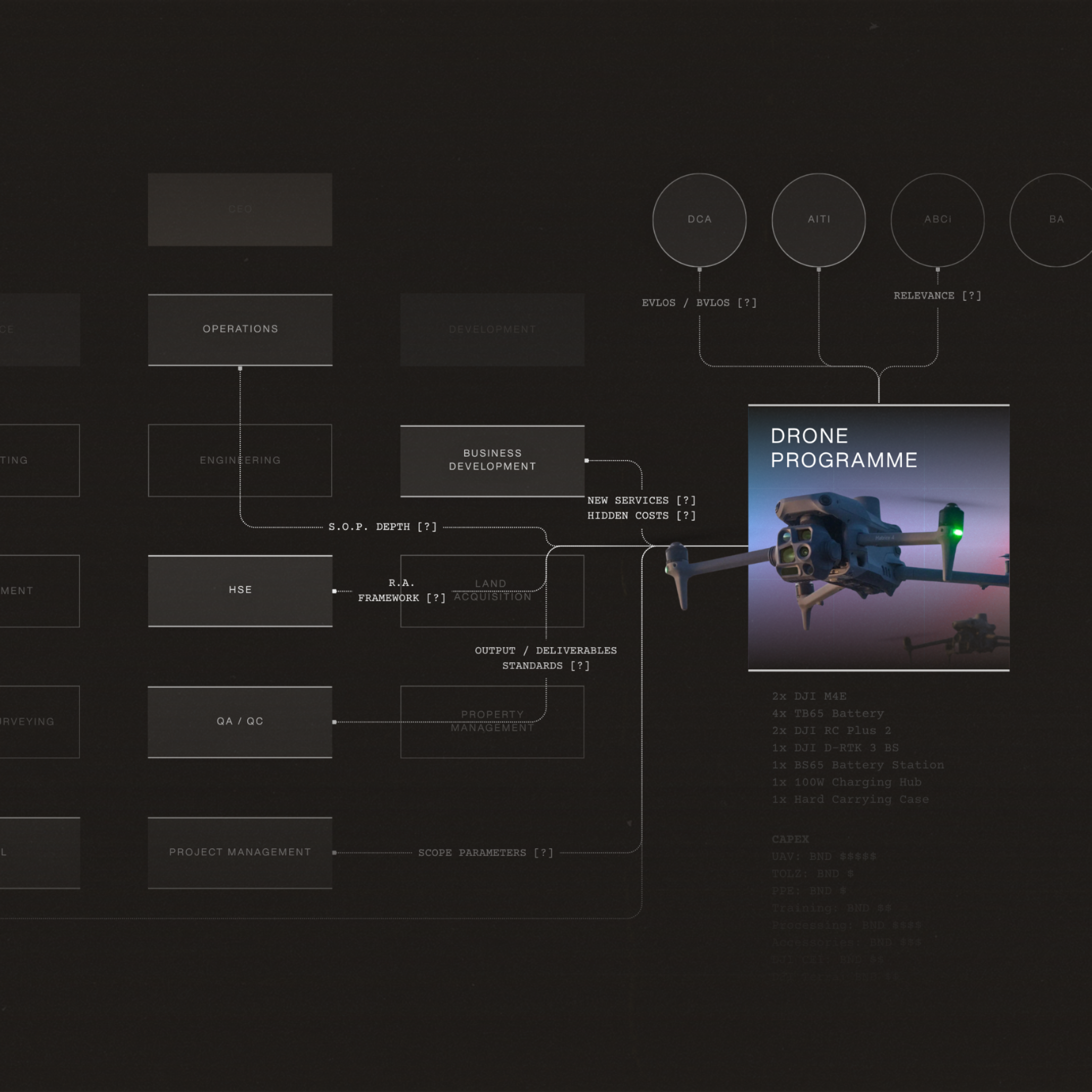
Helping businesses adopt or protect against drones.
The problem we solve:
For businesses considering or using drones.
Regardless of industry, businesses often underestimate the regulatory, technical, and safety hurdles required to deploy drones. We assess your exact context to determine what you actually need.
For property owners and site managers.
Drone-related damages, privacy breaches, and incidents happen more often than people realise, and most site managers are unprepared. We collaborate to mitigate against the specific risks surrounding your property before an incident occurs.
How it works:

Discussion call or meeting.
We share contexts and ideas to determine whether the service is right for you. Entirely collaborative and discrete. No sales pitching.

Preliminary assessment.
If potential solutions are available, we’ll do a free check and return with options. You decide if the benefits are worth it. No expectations.

Delivery and support.
Based on your context, we deliver what you need, whether it’s general advice, reports or documentation. After that, we’ll be around to support if needed.
For businesses considering or using drones.
Business Feasibility Review
For determining the business impact.
-
Businesses considering drones but it would likely involve a new, different capability to what they are used to (e.g., a manned security company doing aerial surveillance.)
Typically, companies also undertake this Review when buying a drone is considered a significant investment. Below are some examples of business size against drone procured:
SMEs: Mid-range consumer drones and above (e.g., DJI Mini’s and Mavic’s.)
Large and Corporate: Enterprise drones (e.g., DJI Matrice 400, dedicated payloads, or even fuel-based fixed-wing platforms.)
-
Used to clarify whether drone systems are worth the cost-to-benefit investment. This is done by referencing:
Projected Costs: Such as equipment, training, compliance, maintenance, per-mission mobilisation and more.
Revenue Potential: Primary and secondary research on potential revenue channels for the new drone service(s). Note, due to limited local data, availability of this component is on a case-by-case basis.
We do not provide financial or investment advice.
-
Before any decision on committing to drones is made.
This is one of the last low-cost chances to exit the procurement process, and a report costs only a fraction of what a poorly informed purchase would.
Operations Manual (OM)
For ensuring safety and compliance.
-
As an industry-standard document. If a company has already committed to drones, but wants to keep it as simple as possible, the OM is the primary organisational asset to have.
Almost all operators need it, regardless of team size, scope or frequency. However, it becomes more critical when teams become larger, scopes are more complex, or if missions are more frequent.
It ensures operations are run effectively, efficiently, and most importantly, legally and safely to mitigate against serious compliance and business risks.
-
It will act as the rule-book for operators and their team(s), telling everyone what exactly to do. While each OM will differ, it generally includes:
Local Rules and Regulations
Roles and Responsibilities
Pre-Operations: Planning and Preparation
Operations
Emergency Procedures
Post-Operations: Data Handling and Maintenance
Typically, the OM is read by:
Internal Teams: Functions as a combined SOP for smaller teams and a quick-reference guide for larger ones.
Clients and Regulators: Demonstrates to external parties that your operations are planned, legal, and conducted to a defined standard. Commonly attached to tender bids and permit applications.
Insurers and Law Enforcement: In the event of an incident, it serves as supportive documented evidence that your organisation took reasonable steps to identify and mitigate foreseeable risks.
-
As soon as a drone procurement decision is confirmed, development should begin immediately. Your team will need several weeks to review, train against, and test the procedures before operations begin.
Concept of Operations (ConOps)
For executing a new mission scope.
-
As an industry-standard document, ConOps are typically used for a wide range of applications. The intention is to ensure all operational factors are considered before any commitments are made. Below are examples of when they are used:
Purchasing Drones for a Non-compliant Drone Operations: Intending to conduct missions outside of the Department of Civil Aviation’s (DCA’s) allowed parameters.
Tender or Contract Compliance: Often required by corporate clients in high-risk and high-compliance sectors.
Pre-Mission Assessment: When approaching a new scope or operational context (e.g., your team might be experienced with urban and jungle operations, but this would be the first time offshore.)
-
Internal Operations Teams: Establishes a shared understanding of what the drone programme is intended to do, how it will be structured, and what resources and conditions it requires.
Regulators and Permit Authorities: Mostly important for operations outside standard flight limits. Mitigate the risk of investing in a drone only to have Flight Permits rejected. Submitting a ConOps first for preliminary feedback.
-
For procurement decisions: After the Business Feasibility Review confirms that drone adoption is worth pursuing, and before any procurement commitment is made. Getting the ConOps right at this stage prevents costly misalignment between what the business expects drones to do and what is actually permissible and achievable.
For new operational contexts or missions: Even after procurement, it is common industry practice by serious operators to submit a ConOps to a client and regulator prior to mission commencement to confirm their approval. This helps ensure clear expectations on all sides, particularly for more complex or sensitive operations.
Standard Operating Procedures (SOPs)
For implementing quality and consistency.
-
Typically considered for businesses where the following exists:
Quality Requirements: Where QA and QC is an important factor.
Layered Organisations: Multiple teams, assets and systems are overlapping.
Higher Complexity: Large or difficult outputs and deliverables are part of the organisation.
Where the OM covers your entire operation end-to-end, each SOP goes one level deeper on a single task:
A typical SOP library for a drone programme might include procedures for equipment setup and pre-flight checks, specific mission types such as aerial surveys or infrastructure inspections, emergency responses, and post-flight reporting.
The exact set depends on what your operation actually does (e.g., a construction monitoring team could have a very different SOP library than a security patrol operator.)
-
Pilots and Ground Crew: The primary day-to-day users. SOPs give field teams a clear reference for specific tasks, removing ambiguity and reducing the likelihood of error at the mission level.
Operations Managers and Supervisors: Used to standardise how tasks are performed across teams, and to hold staff accountable to a defined process at the organisational level.
Clients and Regulators: Signals that your organisation operates to a consistent, documented standard, not just on paper, but at the task level. Frequently requested during audits and complex project onboarding.
Insurers: In the event of an incident, SOPs demonstrate that task-level risks were identified and procedurally controlled.
-
Ideally alongside your OM, so both documents are aligned from the start. However, clients often prefer to create the OM first, gain experience, and then develop an SOP soon after.
For organisations with multiple mission types or departments, SOPs are developed progressively, prioritising the highest-frequency or highest-risk tasks first, then expanding coverage over time.
As an SOP is by far the most variable type of document out of our offerings, kindly request free consultation for more accurate diagnosis for requirements.
For property owners and site managers.
Drone Policy Statement
For sites commonly receiving mission requests.
-
Primarily for organisations facing frequent, ad-hoc flight requests from third parties. Most commonly in Brunei, this comes from freelance drone pilots with photo or video missions.
As a baseline, below are examples of organisations that require a standardised policy statement:
Commercial and Industrial Sites: Managing ports, factories, or logistics hubs where unauthorised drone presence poses security and operational disruptions.
Critical Infrastructure: Managing utility plants, chemical facilities, or high-value assets that need clear boundary restrictions and communication to the public.
Public and Recreational Spaces: Managing hotels, parks, or open-air venues where public safety, privacy, and guest experience are paramount.
-
External Drone Operators: Serves as the primary public filter. Third-party pilots must read and sign off on this statement before submitting any flight requests, immediately screening out non-compliant applicants.
Site Management and Reception Staff: Used as a clear, immediate gatekeeping tool to manage cold calls, emails, or on-site inquiries regarding drone flights, ensuring consistent communication without requiring technical knowledge.
Legal and Executive Teams: Establishes the organisation’s baseline liability boundary and formal corporate position, protecting the property against unauthorised aerial trespass and privacy violations.
-
Proactive Risk Mitigation: Drafted immediately as part of establishing baseline site governance. It should be implemented before public or third-party drone requests escalate, ensuring the organisation is not forced to make ad-hoc, unvetted security decisions on the spot.
Property or Asset Onboarding: Developed during the commissioning phase of a new facility, commercial development, or industrial site, integrating aerial property rights into standard estate rules from day one.
Corporate Policy Updates: Revised annually or whenever local civil aviation (DCA) frameworks update their general flight boundaries, ensuring your public-facing rules align with current national regulations.
Drone Access Review (Advisory)
For owners with Support Letter requests.
-
As drone operators would require Support Letters from site owners for their DCA Flight Permit approval, this hourly advisory scope can quickly review whether to agree supplying one or not.
Below are examples of when this is used:
Technical Information Gaps: When internal management teams lack the domain expertise to evaluate third-party flight risk assessments, pilot competencies, or equipment airworthiness.
Complex and High-Risk Sectors: Facilities operating within heavy industry, energy, or urban infrastructure where approvals require strict, independent verification of operational compliance.
Liability Protection: When asset owners require a structured, audited framework to justify granting site access, ensuring that every allowed flight meets national safety standards.
-
Site Authorities and Managers: Used as an objective, third-party decision matrix to evaluate a flight request. It translates complex pilot submissions into a clear risk profile, allowing managers to make an informed "yes" or "no" decision.
Compliance Officers: Serves as the formal audit trail justifying why an operation was permitted, proving that corporate due diligence was executed before site access was granted.
The DCA and Regulators: The final output, the Support Letter, is submitted directly by the drone operator to the DCA as mandatory proof of landowner permission, clearing the path for official regulatory approval.
-
The "Grey Area" Request: Utilised on a case-by-case basis whenever a third-party operator submits a complex or non-standard flight request that falls outside your standard Drone Policy Statement, leaving management uncertain of the liability.
DCA Support Letter Application: Triggered systematically at least 3 to 4 weeks prior to the scheduled flight date. This allows sufficient time to audit the pilot’s paperwork, run the safety assessment, and issue the formal Support Letter required for their official DCA approval.
Project Conception / Tender Phase: Engaged the moment an internal department or a long-term contractor proposes using drones for site inspections, surveying, or media production, well before contracts are finalised.
Drone Incident Report Procedure
For areas with regular aerial activity.
-
Essential for site management teams to handle unauthorised or hazardous drone activity effectively. It establishes a definitive chain of command and action plan for on-site personnel when an incident occurs.
This is typically for sites with high aerial activity or elevated risk profiles, including:
High-Density Industrial Hubs: Sites experiencing frequent industrial or commercial drone flights where immediate differentiation between authorised and rogue operations is necessary.
High-Security and Restricted Zones: Facilities where a drone sighting or asset collision requires rapid escalation, evidence preservation, and formal regulatory reporting.
Event Venue Managers: Handling temporary or high-capacity gatherings where immediate response protocols minimise risks to public safety and ground assets.
-
On-Site Security and Field Staff: The direct, step-by-step action plan during an active drone incident. It tells personnel exactly what data to capture (e.g., pilot location, drone model, flight path) and how to handle immediate safety risks.
Operations Managers and Supervisors: Used to establish a clear chain of command and escalation matrix, defining exactly when to notify senior management, legal teams, or local authorities.
Regulatory and Legal Advisors: Acts as the official record-keeping framework. The resulting incident reports provide the standardised evidence for insurance claims, police reports, or submissions to the DCA.
-
HSE & Security Integration: Developed during the drafting or updating of your site’s broader Health, Safety, and Environment (HSE) manual or Emergency Response Plan (ERP). It bridges the gap between traditional ground security and modern aerial threats.
Prior to High-Activity Operations: Implemented immediately if a site is transitioning into a phase of heavy aerial presence, such as undergoing major structural asset inspections, entering a prolonged construction phase, or hosting large-scale public events.
Post-Incident Review: Mandated immediately following a "near-miss" or an uncoordinated drone sighting on-site, moving the organisation from an exposed, reactive posture to a structured emergency workflow.