
Potential Drone Opportunities within RKN12
Overview
The 12th National Development Plan (Rancangan Kemajuan Negara 12) or RKN12 is Brunei's five-year government capital expenditure blueprint, covering 2024 to 2029. Published by the Ministry of Finance and Economy, it allocates BND 4.0 billion across 305 projects, organised under six strategic thrusts that support Wawasan Brunei 2035.
The plan is not a regulatory framework and it does not dictate private sector behaviour. What it does is signal where public money is going, and in doing so, shapes procurement opportunities, institutional priorities, and the conditions under which new technologies either gain traction or get ignored.
For the UAS sector specifically, RKN12 is best understood as a demand signal, not a development mandate. The government is not building a drone industry, but it is funding projects where drone technology is either already in-use or is the most rational solution. Businesses that can read those signals early are better positioned to engage.
Explicit Statements on Drones
RKN12 references unmanned aerial systems directly in two projects:
New Building for UAS Squadron (Royal Brunei Airforce, Ministry of Defence)
Purpose-built facility at Rimba Air Force Base to house the Royal Brunei Air Force's Squadron 39 and its five Boeing Insitu RQ-21 Blackjack drones. Construction began January 2024; targeted completion March 2025.
Aerial Photography & 3D Mapping (Survey Department, Ministry of Development)
National geospatial data update covering aerial imagery and 3D mapping products for Brunei Darussalam. Under RKN11, this was done with a manned helicopter, however the method for RKN12 is unspecified.
The defence project is infrastructure-only, i.e., the drones already exist. RKN12 funds the building that properly houses and sustains them, a signal of institutional commitment to UAS as a permanent capability, not a procurement opportunity for the civilian market.
The Survey Department project is the more commercially relevant of the two. The output, 3D mapping products for national geospatial data, is exactly what drone-based LiDAR and photogrammetry delivers at lower cost per hectare (for moderate sized scales) than manned aircraft. Whether the procurement specification allows for that method will depend on how the tender(s) is written.
Implied Opportunities
RKN12 was written by development planners, not UAS practitioners, and projects are described by their intended outputs, not by the methods used to achieve them. That gap, between what agencies are funded to produce and how they will produce it, is where the prospective opportunity sits.
Six projects in the plan carry strong implied demand for drone technology, even though none of them name it:
Utility Mapping (IT Unit, Ministry of Development)
Above-ground utility corridors (e.g., power lines, pipe runs, access tracks) are a direct drone application. LiDAR mapping produces asset registers faster and at lower cost than ground survey teams. The IT Unit's data-output focus suggests GIS-ready deliverables, which aligns with drone-derived datasets.
IoT Pipe & Sewerage Monitoring (Public Works Department, Ministry of Development)
IoT sensors cover underground infrastructure, while drone inspection covers the above-ground runs that sensors may miss (e.g., physical damage, joint failures, vegetation encroachment). The two approaches are complementary, and PWD's investment in monitoring as a concept creates a potentially receptive environment for the conversation.
National Housing Earthworks & Site Investigation (Housing Development Department, Ministry of Development)
Multiple housing phases (i.e., Kg. Lumut, Kg. Rimba, Kg. Salambigar) include earthworks development and site investigation. Volumetric surveys, cut-and-fill calculations, topographic mapping before construction, and progress monitoring are all established drone use-cases.
Road Infrastructure Rehabilitation (Public Works Department, Ministry of Development)
Road improvement projects recurred heavily under RKN11 and are expected to continue under RKN12. Linear infrastructure (i.e., roads, drainage, shoulders) are surveyed faster and more cheaply by drone than by ground teams. Condition assessment and drainage mapping are the primary entry points.
C4ISR System Replacement (Ministry of Defence)
C4ISR (command, control, communications, computers, intelligence, surveillance, and reconnaissance) is being replaced. The RQ-21 fleet feeds directly into this architecture and the investment likely includes ground control systems and data links that expand UAS operational capacity, even though it is not labelled a drone project.
Digital Economy Masterplan 2025 (Multiple Ministries)
RKN12 references the Digital Economy Masterplan across nine clusters: logistics, energy, agri-food, tourism, and others. Each of these sectors has established drone applications globally. None are explicitly called out in the plan. The Masterplan's focus on industry digitalisation is the most open-ended policy lever available and the most relevant one for making the case to enterprise clients.
On the surface, RKN12 positions UAS as a defence and survey matter, however to limit to that reading would be incomplete. Six additional projects across infrastructure, housing, utilities, and digital economy carry clear implied demand that the plan's authors never named, but that any organisation with the right capability can move to address.
The question is not whether the opportunity exists, rather it is whether the procurement process is written broadly enough to accommodate it, and whether the right conversations are happening before the tenders are issued.
About Us
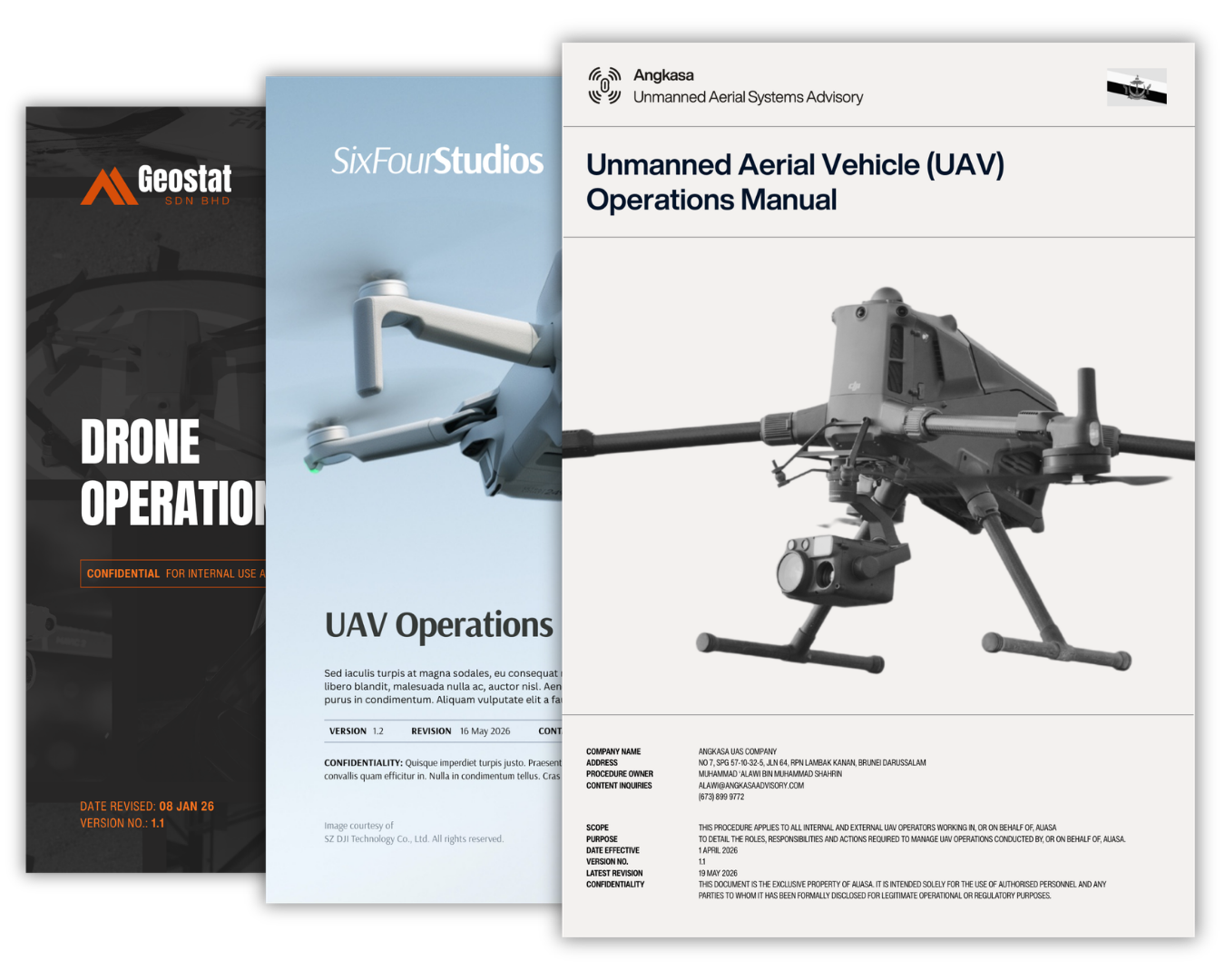
Angkasa is a Brunei Darussalam-based Unmanned Aerial Systems (UAS) business, helping organisations with drones via research, documentation and advisory work. We do not sell drone ops or hardware, allowing us to provide objective, unbiased work to our clients and ensure they are able to grow in a way that’s best for their unique contexts.
To learn more, contact UAS Advisor, Alawi, at alawi@angkasaadvisory.com or (673) 8999 772.
__________
AI Policy: All content is authored and developed entirely by in-house. Artificial intelligence is strictly utilised for supporting tasks such as structuring, grammar refinement, and proofreading to ensure originality, quality and relevance.
